Combo Guided Tour: Basilica Cistern + Blue Mosque + Hagia Sophia with Skip-the-Line Tickets (Skip the Line Tickets with English Guided Tour)Combo Guided Tour: Basilica Cistern + Blue Mosque + Hagia Sophia with Skip-the-Line Tickets (Skip the Line Tickets with English Guided Tour) - 1Combo Guided Tour: Basilica Cistern + Blue Mosque + Hagia Sophia with Skip-the-Line Tickets (Skip the Line Tickets with English Guided Tour) - 2Combo Guided Tour: Basilica Cistern + Blue Mosque + Hagia Sophia with Skip-the-Line Tickets (Skip the Line Tickets with English Guided Tour) - 3

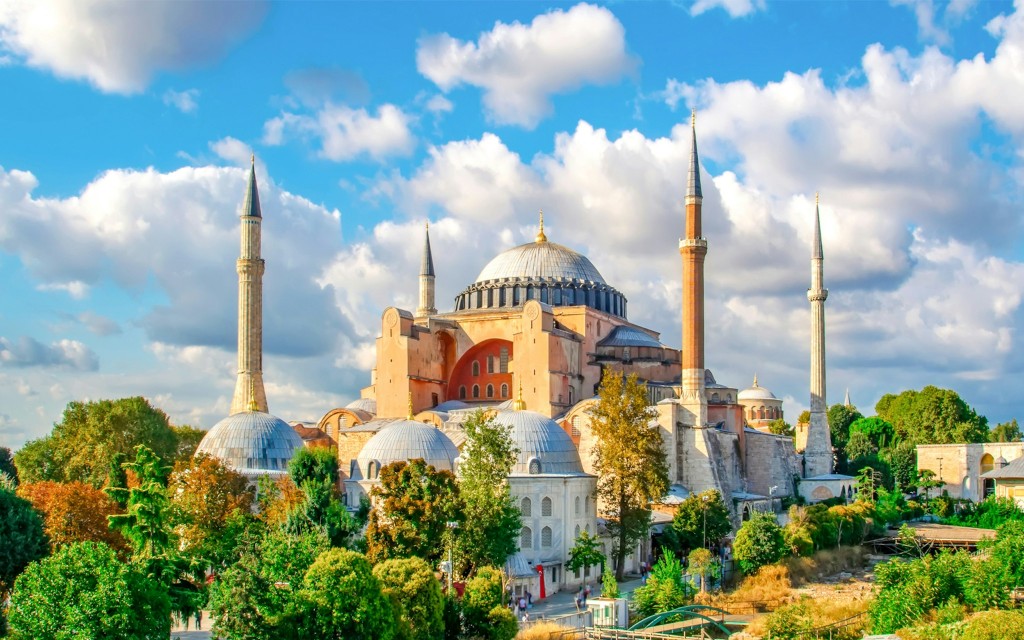
Discover the beauty and grandeur of the Hagia Sophia through these stunning photographs.

The Hagia Sophia, also officially known as the Hagia Sophia Grand Mosque or Ayasofya in Turkish, is one of the most important and visited landmarks in Istanbul and across all of Turkey. For centuries, it has stood at the heart of the city’s history, admired for its monumental scale, architectural brilliance, and deep spiritual significance. Originally constructed in the 6th century as a Christian cathedral under the Byzantine Emperor Justinian I, it was later transformed into a mosque during the Ottoman period, reflecting the city’s layered past.

Today, Hagia Sophia functions as an active mosque while welcoming visitors from around the world. Inside, Byzantine and Islamic elements come together in a remarkable harmony, from soaring domes and luminous mosaics to elegant calligraphy and towering minarets. Millions of visitors enter Hagia Sophia each year to experience its atmosphere and understand its cultural importance. Planning ahead by reserving tickets or tours in advance is recommended to ensure a smooth and meaningful visit to this iconic monument.

From€113.40
ADULT
7–99 age
€113.40
CHILD
0–6 age
€113.40
Duration
3 hours
Meeting Point
Istanbul
Binbirdirek, Dsign Cafe, At Meydanı Cd, Fatih/İstanbul, Türkiye
Opening Hours
Open daily from 9 AM to 7 PM (except prayer times)
Visit Duration
The average visit duration for Hagia Sophia is between 1 to 2 hours.
Best Time to Visit
Visit right after opening or late afternoon for fewer crowds and better light.
Address
Sultan Ahmet, Ayasofya Meydanı No:1, 34122 Fatih/İstanbul
Dress Code

As Hagia Sophia is an active mosque, a modest dress code is required for all visitors:

Women should wear knee-length or longer skirts or full-length trousers, cover shoulders and arms, and wear a headscarf inside the mosque. 

Men are required to wear full-length trousers or knee-length shorts, and sleeveless shirts are not permitted. 

The dress code is more relaxed for children under eight years old. 

Experience details at a glance

What's Included

  • 1-hour guided tour of Basilica Cistern
  • Skip-the-line entry
  • Expert English-speaking guide
  • Audio app downloadable in English, German, French, Italian, Russian, Spanish, & Turkish
  • 2-hour guided tour of Hagia Sophia
  • Skip-the-line entry
  • Expert English-speaking guide
  • Entry to Hagia Sophia visiting area & Upper Gallery
  • Audio guide downloadable in English, German, French, Italian, & Spanish
  • 1-hour guided tour to the Blue Mosque
  • Skip-the-line entry (as per option selected)
  • Expert English-speaking guide

What's Excluded

  • Scarf and body cover at the Blue Mosque & Hagia Sophia

Your experience

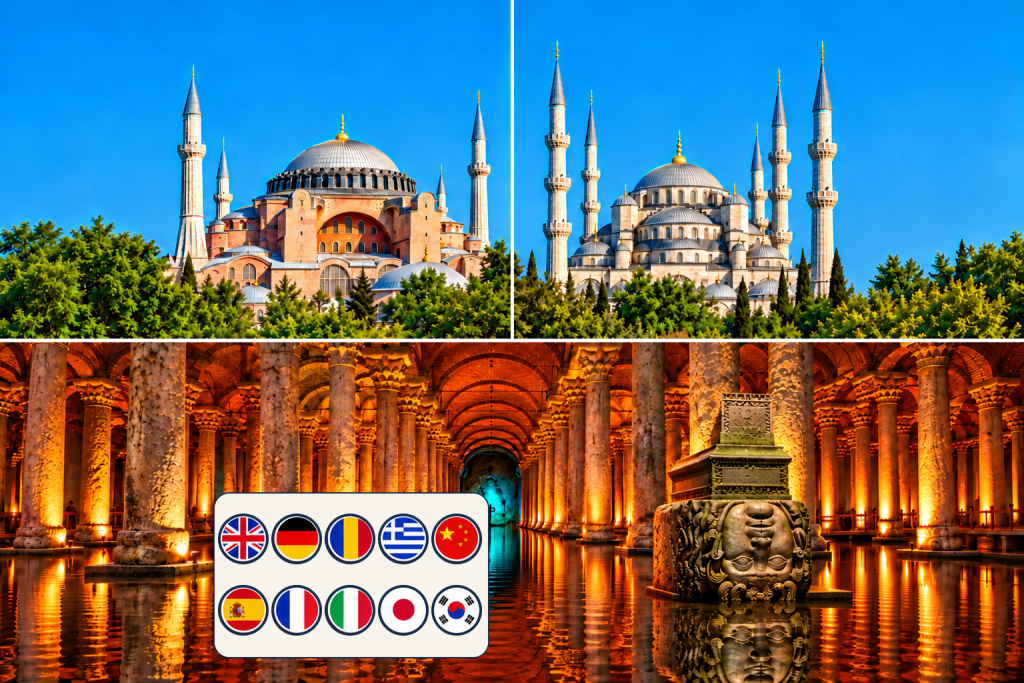
Check these three must-visit locations in Istanbul off your list with one ticket. Explore the Basilica Cistern, Hagia Sophia, and the Blue Mosque in just a few hours, without waiting for long entry lines or hassles. Expert storytelling and a mix of live guided tours and multilingual audio guides, this experience brings centuries of history to life. All sites are within walking distance, making this an efficient and enriching way to see the city’s highlights in a single day.

Basilica Cistern

Explore the 6th-century underground water reservoir, which is the Basilica Cistern. As you walk on raised platforms above the water, you’ll be surrounded by more than 300 marble columns, many repurposed from ancient temples. Walk to the far end of the cistern to see the ancient Medusa heads, resting beneath the surface. Continue exploring the site at your own pace with your audio guide, available in 7+ languages.

Hagia Sophia

Step into Hagia Sophia and its Upper Gallery, where emperors once watched religious ceremonies from above. Catch the golden mosaics and the fusion of Christian and Islamic art and architecture, all under one massive dome. Learn about the stories from Hagia Sophia’s time as a church, mosque, and museum with an expert English-speaking guide and a multilingual audio guide.

Blue Mosque

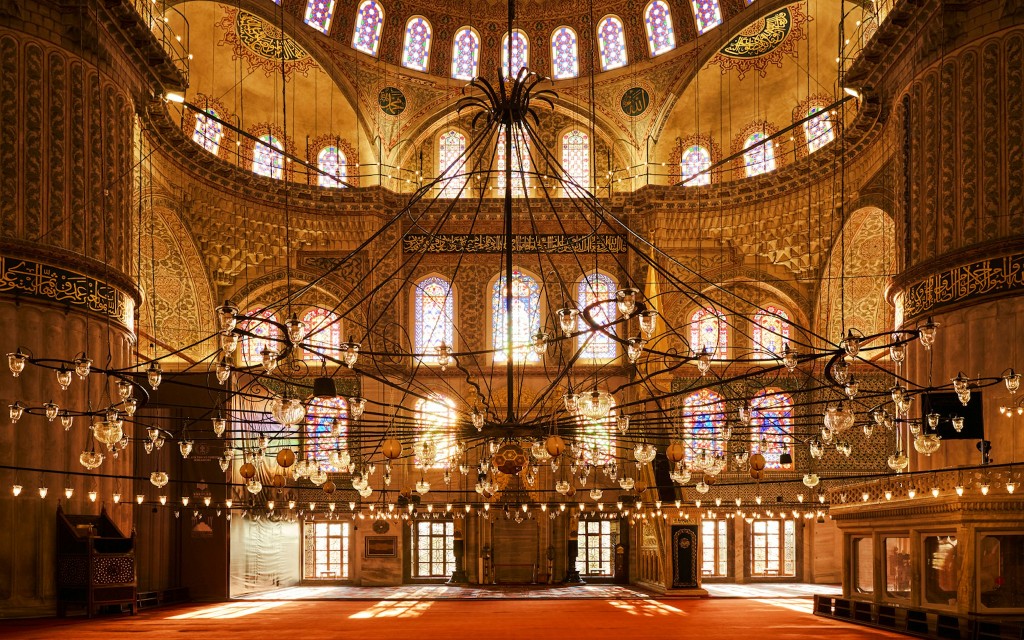
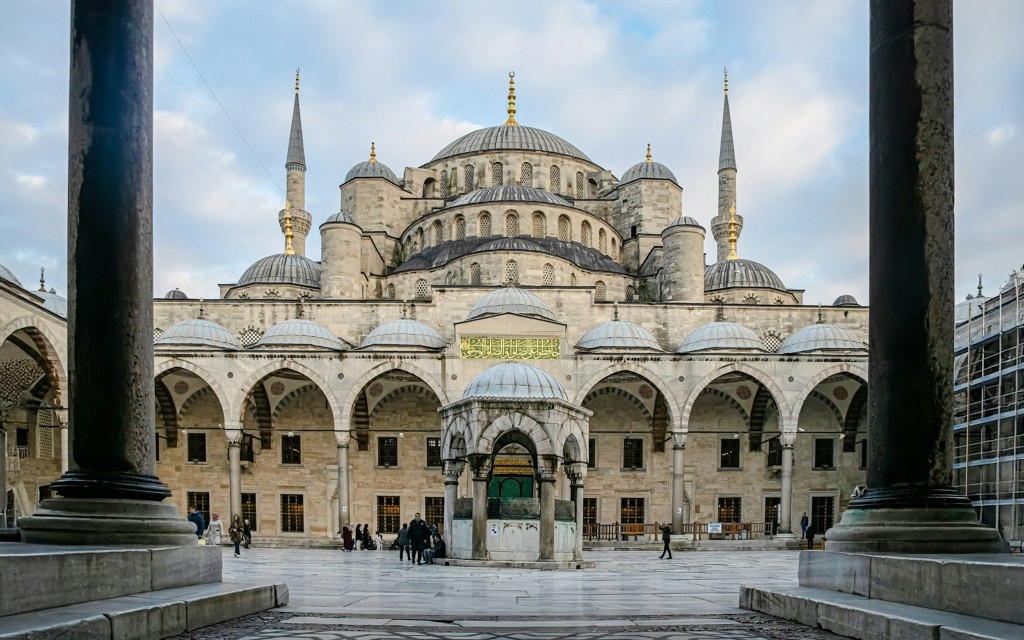
Explore the Blue Mosque, famous for its six minarets and brilliant blue İznik tilework. Enter the vast prayer hall, gaze at its architectural design, and learn how it continues to function as an active place of worship today. Don’t forget to look up—the soaring domes and painted ceilings are as impressive as the space below.
Know Before You Go

Know before you go

What to bring

Basilica Cistern

  • Choose sturdy shoes with a good grip, as some areas may be wet or slippery.

  • Stay ahead of the game and download the audio app beforehand to avoid any network glitches at the location.

  • Make sure your phone is fully charged for tickets, photos, and audio use.

  • The underground remains cool and damp even in the summer. Bring along a light jacket or layer to stay warm.

Hagia Sophia

  • Wear supportive shoes and consider bringing a hat, sunglasses, and a refillable water bottle for comfort outside.

  • Keep earphones handy if you plan to use an audio guide.

  • Bring some cash for nearby cafés, souvenirs, or small purchases.

Blue Mosque

  • Wear modest clothing that covers your shoulders and knees.

  • Women should bring a headscarf for entry into prayer areas.

  • Carry a small bag to hold your shoes when you take them off at the entrance.

What's not allowed

Basilica Cistern

  • Flash photography is not allowed, as it disrupts the lighting and other visitors.

  • Tripods and selfie sticks are prohibited due to space and safety concerns.

  • You cannot eat or drink inside the cistern.

Hagia Sophia

  • Visitors are not permitted in certain areas during prayer times.

  • Flash photography is not allowed.

  • Visitors are required to dress modestly – so please cover your head, shoulders, and knees. Women are also required to wear scarves.

Blue Mosque

  • Shoes must be taken off before entering and cannot be worn inside the mosque.

  • Clothing that exposes shoulders or knees is not permitted; dress modestly.

Accessibility

Basilica Cistern

  • The site is not wheelchair accessible, as the interior has uneven, damp flooring and low lighting that make movement unsafe.

Hagia Sophia

  • The site is not wheelchair accessible; while the ground floor can be reached by ramps, the Upper Gallery remains off-limits due to steep and uneven historic stairways.

Blue Mosque

  • The site is not wheelchair accessible, as entry involves cobblestone paths and small steps that make independent access difficult.

Additional information

Basilica Cistern

  • Your ticket allows you to skip the ticket queue, but all visitors must go through a security check.

  • Arrive early in the morning or visit in the evening to avoid crowds from cruise ship tours.

Hagia Sophia

  • Due to ongoing renovations, certain sections of the interiors may be obstructed by scaffolding.

  • You can bypass the ticket lines, but the security check is mandatory and can take up to 60 minutes between June and August.

  • The ground floor is reserved for prayers, while the second floor is accessible to visitors.

Blue Mosque

  • You can skip the ticket line, but security checks apply to all visitors and may take up to 60 minutes during busy hours.

  • You can buy a scarf or a body cover at the entrance for €1 and €3.

Instructions

- English-speaking guide in Basilica Cistern - English-speaking guide in Blue Mosque - English-speaking guide in Hagia Sophia (exteriors only; multilingual audio guide for the interiors) - Skip-the-line entry to Basilica Cistern - Skip-the-line entry to Hagia Sohpia - \*Entry to Blue Mosque is free

About Hagia Sophia Tickets, Tours & Visitor Information

Hagia Sophia, meaning "Holy Wisdom", stands as a testament to the evolving cultural and religious landscape of Istanbul. Consecrated as a cathedral in 537 AD, it served as the center of Eastern Orthodox Christianity for centuries, famed for its massive dome, a marvel of Byzantine engineering. 

In 1453, following the Ottoman conquest of Constantinople, Hagia Sophia was converted into a mosque, with the addition of minarets and Islamic decorative elements, while much of the Byzantine mosaic art was preserved. In the 20th century, it was designated a museum, attracting visitors from around the globe who came to admire its unique synthesis of Christian and Islamic art. In 2020, Hagia Sophia was re-designated as a mosque. 

Today, the Hagia Sophia is a functioning mosque that welcomes both worshippers and tourists. Its vast prayer hall is a powerful reminder of Istanbul's layered past and present. Visitors are welcome to explore this historical site while respecting its religious function. To enhance your visit, consider exploring options for guided tours that provide deeper insights into its history and art.

Highlights

Begin your experience at the Blue Mosque, where over 20,000 hand-painted tiles and stained-glass windows create a calm, glowing space of worship and design.
Take in the grandeur of Hagia Sophia’s Upper Gallery, look up at its golden mosaics, and uncover centuries of imperial history with your audio guide.
Explore the hidden terrains of the Basilica Cistern, where rows of ancient columns stand in water and the haunting Medusa heads wait in the shadows.
Enjoy the comfort of exploring Istanbul’s most iconic landmarks with skip-the-line tickets, an expert guided tour, and multilingual audio guides, all in one day.

Why Book Online?

Booking Hagia Sophia tickets online offers several advantages. As one of the most visited landmarks in Istanbul, long queues often form at the entrance, especially during peak tourist seasons. Purchasing tickets in advance helps secure entry and saves valuable time. Booking online through our website allows you to compare different ticket types and available deals, including skip-the-line access, guided tours, and combo packages with other Istanbul attractions.

History

The Hagia Sophia has a rich and complex history that spans across empires and religions. Originally constructed as a Christian cathedral in the 6th century AD during the reign of Emperor Justinian I, it was the largest church in the world for many centuries and a center of Eastern Orthodox Christianity. 

The original structure was built on the site of two earlier churches that had been destroyed by riots. Following the Ottoman conquest of Constantinople in 1453, the Hagia Sophia was converted into a mosque by Sultan Mehmed II. Islamic architectural elements, such as minarets, a mihrab, and minbar, were added, while many of the Byzantine mosaics were covered. 

The Hagia Sophia remained a mosque until 1935 when it was turned into a museum by the Turkish Republic. In 2020, it was re-designated as a mosque. Throughout its history, the Hagia Sophia has been a symbol of power, faith, and cultural exchange, reflecting the diverse heritage of Istanbul.

Opening Hours

Hagia Sophia is open to visitors every day from 9:00 AM to 7:00 PM, with the last entry at 6:30 PM.

As an active mosque, visiting hours are coordinated around the daily Islamic prayer schedule. There are five prayer sessions each day, during which Hagia Sophia is fully closed to tourists, typically for about 75 to 90 minutes.

The most significant closure occurs on Fridays from 12:30 PM to 2:30 PM, when the mosque is reserved exclusively for the main weekly prayer. Outside of prayer times, visitors are welcome to explore the monument.

Best Time to Visit

The best time to visit Hagia Sophia is early in the morning, shortly after it opens, or later in the afternoon. Mondays and Tuesdays are generally the calmest days. To avoid crowds and access restrictions, it is best to skip Fridays, weekends, and major Islamic holidays.

Be aware that as an active mosque, there are 5 prayer sessions each day, during which tourist access is restricted. It is recommended to check the prayer schedule in advance and avoid visiting immediately after prayers, as visitor numbers can be higher at those times.

What to See Inside

Inside the Hagia Sophia, visitors can explore a variety of historically and artistically significant areas. 

  • The main prayer hall is dominated by the massive central dome, supported by impressive columns and arches. 
  • The walls and ceilings are adorned with a mix of original Byzantine mosaics and Islamic calligraphy, reflecting the building's diverse history.
  • Upper galleries offer closer views of the mosaics, including depictions of Christ, the Virgin Mary, and Byzantine emperors and empresses.
  • The mihrab indicates the direction of Mecca, a later addition when the building was converted into a mosque. 
  • Other notable features include the imperial gate, once used only by emperors, and the ablution fountain, used for ritual cleansing before prayer. 
  • The tomb of several Ottoman sultans and princes are located outside the main structure, and can also be visited. Visitors should allocate sufficient time to fully appreciate the scale and detail of this historical monument.

Things to Know

Before visiting the Hagia Sophia, there are a few important things to keep in mind. 

  • As an active mosque, visitors are expected to dress respectfully (see dress code). 
  • Visitor tickets provide access to the Visiting Area (Upper Gallery); the main prayer hall on the ground level is reserved for worshippers and is not included in standard tourist visits.
  • The mosque is fully closed to tourists during daily prayer times and on Fridays during the main weekly prayer. Visiting outside these hours is strongly recommended.
  • Security checks are required at entry; waiting times can take up to 60 minutes during high season (June to August).
  • It's advisable to allocate at least 1-2 hours for your visit to fully appreciate the architecture and historical significance. 
  • Guided tours or audio guides are recommended for deeper insight into the history, symbolism, and artistic details.
  • Due to ongoing conservation and renovation work, some interior sections may be partially obscured by scaffolding.
  • Combo tickets are a practical option and can save time and money when visiting nearby landmarks such as the Basilica Cistern and the Topkapi Palace.

Visitor Rules

When visiting the Hagia Sophia, please observe the following rules:

  • Dress modestly, covering shoulders and knees (see dress code).
  • Remove your shoes before entering the prayer area. Visitors may leave them on the designated racks or bring a small plastic bag to carry them during their visit.
  • Maintain a quiet and respectful demeanor inside the mosque
  • Photography is generally allowed, but avoid using flash.
  • Follow the instructions of the mosque staff and guides.

Is It Worth Visiting?

Few places in the world capture the depth of history, faith, and architecture as powerfully as the Hagia Sophia. Standing beneath its vast dome, visitors immediately sense the weight of centuries, where monumental scale meets extraordinary detail in mosaics, calligraphy, and stonework shaped by different civilizations.

More than a landmark, Hagia Sophia tells the layered story of Istanbul itself, bridging the Christian and Islamic worlds within a single space. It invites quiet reflection as much as admiration, offering moments of awe that go beyond visual beauty. Whether you are passionate about history, inspired by art, or simply curious to experience one of the world’s great monuments, Hagia Sophia leaves a lasting impression that continues well after you step outside its walls.

Frequently Asked Questions

What is Hagia Sophia?

Hagia Sophia is one of Istanbul’s most iconic landmarks, originally built as a Byzantine cathedral, later converted into an imperial mosque, and today functioning as an active mosque and historic monument. It is renowned for its massive dome, layered history, and unique blend of Christian and Islamic architectural elements.

When was Hagia Sophia built?

Hagia Sophia was constructed between 532 and 537 AD during the reign of Byzantine Emperor Justinian I. At the time of its completion, it was the largest cathedral in the world.

Who built Hagia Sophia?

Hagia Sophia was commissioned by Byzantine Emperor Justinian I as the principal cathedral of Constantinople and a symbol of imperial authority.

Who designed Hagia Sophia?

The structure was designed by two scholars and architects: Anthemius of Tralles and Isidore of Miletus. Their innovative engineering, particularly the dome, was groundbreaking for its time.

What does Hagia Sophia mean?

The name “Hagia Sophia” means “Holy Wisdom” in Greek. It refers to divine wisdom rather than a specific saint.

Why is Hagia Sophia important?

Hagia Sophia is important for its architectural innovation, historical significance, and cultural symbolism. It has served as a cathedral, mosque, museum, and mosque again, reflecting the complex religious and political history of Istanbul. Its dome influenced centuries of church and mosque architecture across both the Christian and Islamic worlds.

Where is Hagia Sophia located?

Hagia Sophia is located in Istanbul’s historic Sultanahmet district, directly opposite the Blue Mosque and within walking distance of major landmarks such as the Basilica Cistern and the Topkapi Palast.

Is Hagia Sophia free to visit?

Access to the main prayer hall of Hagia Sophia is free for Muslim worshippers attending prayer, as it functions as an active mosque. However, the designated visitor areas, including the Upper Gallery, require a ticket. On this page, you can review verified ticket options and available deals for access to the visitor areas.

Where can I buy Hagia Sophia tickets?

Tickets for the designated visitor areas of Hagia Sophia can be purchased online or on-site, subject to availability and current regulations. Booking online through this page allows you to compare verified ticket options, view inclusions, and access current deals, helping you plan your visit more easily, especially during busy periods.

How do you pronounce Hagia Sophia?

Hagia Sophia is commonly pronounced as “HAH-yuh soh-FEE-uh” in English. In Turkish, it is pronounced “Ayasofya.”

How to Get There

Hagia Sophia is located in the Sultanahmet district, making it easily accessible by public transportation. The closest tram stop is Sultanahmet, which is served by the T1 line. From the tram stop, Hagia Sophia is just a short walk away. 

Alternatively, you can take a taxi or a bus to Sultanahmet Square. Walking is also a pleasant option if you are staying in the nearby areas.

Reviews (143)

4.7
Reviews (143)
Showing 13-18 of 143
M
Massimo
Feb 18, 2026

Molto affascinante! Audio guida chiara

B
benedicte
Feb 18, 2026

In alcuni punti l’audioguida risulta un po’ ripetitiva.

J
Jenny
Feb 18, 2026

Good tour!

L
Lourdes
Feb 18, 2026

merece la pena la audioguia

S
Silvia
Feb 18, 2026

Das Erlebnis war sehr gut.

A
Alfonso
Feb 18, 2026

Quel dommage qu’on ne puisse plus accéder au premier étage de Hagia Sophia !

Showing 13-18 of 143
From
€113.40
per person
ADULT
7–99 age
€113.40
CHILD
0–6 age
€113.40
Check Availability
Cancellation PolicyFree cancellation is not included for this option.
Duration
3 hours
Meeting Point
Istanbul
Binbirdirek, Dsign Cafe, At Meydanı Cd, Fatih/İstanbul, Türkiye
Opening Hours
Open daily from 9 AM to 7 PM (except prayer times)
Visit Duration
The average visit duration for Hagia Sophia is between 1 to 2 hours.
Best Time to Visit
Visit right after opening or late afternoon for fewer crowds and better light.
Address
Sultan Ahmet, Ayasofya Meydanı No:1, 34122 Fatih/İstanbul
Dress Code

As Hagia Sophia is an active mosque, a modest dress code is required for all visitors:

Women should wear knee-length or longer skirts or full-length trousers, cover shoulders and arms, and wear a headscarf inside the mosque. 

Men are required to wear full-length trousers or knee-length shorts, and sleeveless shirts are not permitted. 

The dress code is more relaxed for children under eight years old. 

From
€113.40
Check Availability