Hagia Sophia Audio Guide
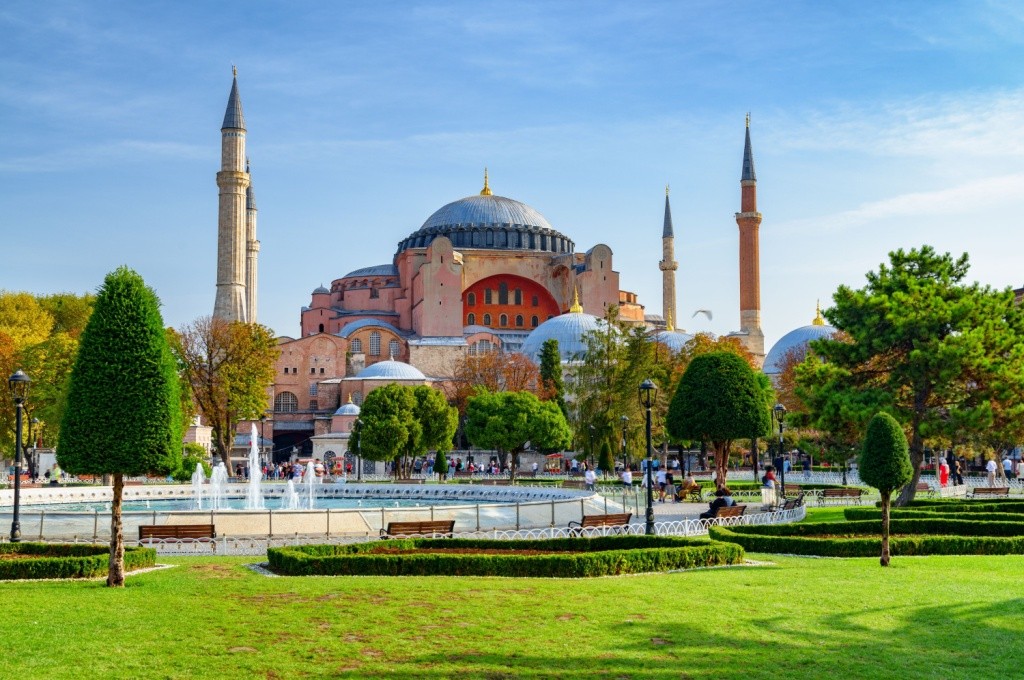
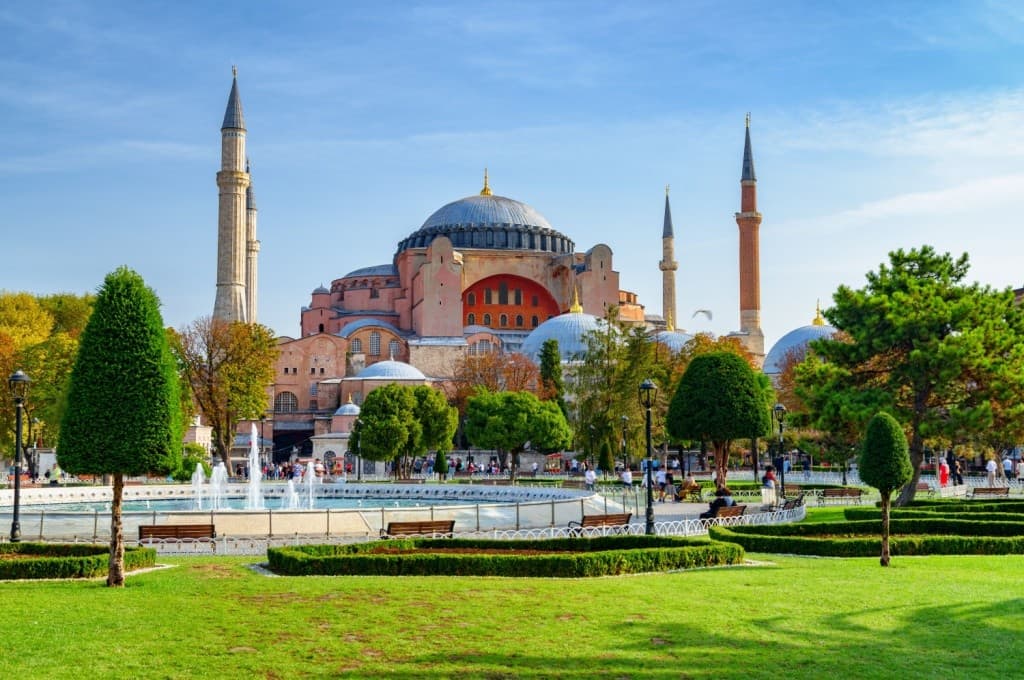
Discover the beauty and grandeur of the Hagia Sophia through these stunning photographs.
The Hagia Sophia, also officially known as the Hagia Sophia Grand Mosque or Ayasofya in Turkish, is one of the most important and visited landmarks in Istanbul and across all of Turkey. For centuries, it has stood at the heart of the city’s history, admired for its monumental scale, architectural brilliance, and deep spiritual significance. Originally constructed in the 6th century as a Christian cathedral under the Byzantine Emperor Justinian I, it was later transformed into a mosque during the Ottoman period, reflecting the city’s layered past.
Today, Hagia Sophia functions as an active mosque while welcoming visitors from around the world. Inside, Byzantine and Islamic elements come together in a remarkable harmony, from soaring domes and luminous mosaics to elegant calligraphy and towering minarets. Millions of visitors enter Hagia Sophia each year to experience its atmosphere and understand its cultural importance. Planning ahead by reserving tickets or tours in advance is recommended to ensure a smooth and meaningful visit to this iconic monument.
As Hagia Sophia is an active mosque, a modest dress code is required for all visitors:
Women should wear knee-length or longer skirts or full-length trousers, cover shoulders and arms, and wear a headscarf inside the mosque.
Men are required to wear full-length trousers or knee-length shorts, and sleeveless shirts are not permitted.
The dress code is more relaxed for children under eight years old.
Discover the timeless beauty of Hagia Sophia with a self-paced audio guide. Explore its remarkable architecture, rich history, and cultural significance at your own pace.
Про Hagia Sophia Tickets, Tours & Visitor Information
Hagia Sophia, meaning "Holy Wisdom", stands as a testament to the evolving cultural and religious landscape of Istanbul. Consecrated as a cathedral in 537 AD, it served as the center of Eastern Orthodox Christianity for centuries, famed for its massive dome, a marvel of Byzantine engineering.
In 1453, following the Ottoman conquest of Constantinople, Hagia Sophia was converted into a mosque, with the addition of minarets and Islamic decorative elements, while much of the Byzantine mosaic art was preserved. In the 20th century, it was designated a museum, attracting visitors from around the globe who came to admire its unique synthesis of Christian and Islamic art. In 2020, Hagia Sophia was re-designated as a mosque.
Today, the Hagia Sophia is a functioning mosque that welcomes both worshippers and tourists. Its vast prayer hall is a powerful reminder of Istanbul's layered past and present. Visitors are welcome to explore this historical site while respecting its religious function. To enhance your visit, consider exploring options for guided tours that provide deeper insights into its history and art.
Чому варто бронювати онлайн?
Booking Hagia Sophia tickets online offers several advantages. As one of the most visited landmarks in Istanbul, long queues often form at the entrance, especially during peak tourist seasons. Purchasing tickets in advance helps secure entry and saves valuable time. Booking online through our website allows you to compare different ticket types and available deals, including skip-the-line access, guided tours, and combo packages with other Istanbul attractions.
Історія
The Hagia Sophia has a rich and complex history that spans across empires and religions. Originally constructed as a Christian cathedral in the 6th century AD during the reign of Emperor Justinian I, it was the largest church in the world for many centuries and a center of Eastern Orthodox Christianity.
The original structure was built on the site of two earlier churches that had been destroyed by riots. Following the Ottoman conquest of Constantinople in 1453, the Hagia Sophia was converted into a mosque by Sultan Mehmed II. Islamic architectural elements, such as minarets, a mihrab, and minbar, were added, while many of the Byzantine mosaics were covered.
The Hagia Sophia remained a mosque until 1935 when it was turned into a museum by the Turkish Republic. In 2020, it was re-designated as a mosque. Throughout its history, the Hagia Sophia has been a symbol of power, faith, and cultural exchange, reflecting the diverse heritage of Istanbul.
Години роботи
Hagia Sophia is open to visitors every day from 9:00 AM to 7:00 PM, with the last entry at 6:30 PM.
As an active mosque, visiting hours are coordinated around the daily Islamic prayer schedule. There are five prayer sessions each day, during which Hagia Sophia is fully closed to tourists, typically for about 75 to 90 minutes.
The most significant closure occurs on Fridays from 12:30 PM to 2:30 PM, when the mosque is reserved exclusively for the main weekly prayer. Outside of prayer times, visitors are welcome to explore the monument.
Найкращий час для відвідування
The best time to visit Hagia Sophia is early in the morning, shortly after it opens, or later in the afternoon. Mondays and Tuesdays are generally the calmest days. To avoid crowds and access restrictions, it is best to skip Fridays, weekends, and major Islamic holidays.
Be aware that as an active mosque, there are 5 prayer sessions each day, during which tourist access is restricted. It is recommended to check the prayer schedule in advance and avoid visiting immediately after prayers, as visitor numbers can be higher at those times.
Що подивитися всередині
Inside the Hagia Sophia, visitors can explore a variety of historically and artistically significant areas.
- The main prayer hall is dominated by the massive central dome, supported by impressive columns and arches.
- The walls and ceilings are adorned with a mix of original Byzantine mosaics and Islamic calligraphy, reflecting the building's diverse history.
- Upper galleries offer closer views of the mosaics, including depictions of Christ, the Virgin Mary, and Byzantine emperors and empresses.
- The mihrab indicates the direction of Mecca, a later addition when the building was converted into a mosque.
- Other notable features include the imperial gate, once used only by emperors, and the ablution fountain, used for ritual cleansing before prayer.
- The tomb of several Ottoman sultans and princes are located outside the main structure, and can also be visited. Visitors should allocate sufficient time to fully appreciate the scale and detail of this historical monument.
Що потрібно знати
Before visiting the Hagia Sophia, there are a few important things to keep in mind.
- As an active mosque, visitors are expected to dress respectfully (see dress code).
- Visitor tickets provide access to the Visiting Area (Upper Gallery); the main prayer hall on the ground level is reserved for worshippers and is not included in standard tourist visits.
- The mosque is fully closed to tourists during daily prayer times and on Fridays during the main weekly prayer. Visiting outside these hours is strongly recommended.
- Security checks are required at entry; waiting times can take up to 60 minutes during high season (June to August).
- It's advisable to allocate at least 1-2 hours for your visit to fully appreciate the architecture and historical significance.
- Guided tours or audio guides are recommended for deeper insight into the history, symbolism, and artistic details.
- Due to ongoing conservation and renovation work, some interior sections may be partially obscured by scaffolding.
- Combo tickets are a practical option and can save time and money when visiting nearby landmarks such as the Basilica Cistern and the Topkapi Palace.
Правила для відвідувачів
When visiting the Hagia Sophia, please observe the following rules:
- Dress modestly, covering shoulders and knees (see dress code).
- Remove your shoes before entering the prayer area. Visitors may leave them on the designated racks or bring a small plastic bag to carry them during their visit.
- Maintain a quiet and respectful demeanor inside the mosque
- Photography is generally allowed, but avoid using flash.
- Follow the instructions of the mosque staff and guides.
Чи варто відвідувати?
Few places in the world capture the depth of history, faith, and architecture as powerfully as the Hagia Sophia. Standing beneath its vast dome, visitors immediately sense the weight of centuries, where monumental scale meets extraordinary detail in mosaics, calligraphy, and stonework shaped by different civilizations.
More than a landmark, Hagia Sophia tells the layered story of Istanbul itself, bridging the Christian and Islamic worlds within a single space. It invites quiet reflection as much as admiration, offering moments of awe that go beyond visual beauty. Whether you are passionate about history, inspired by art, or simply curious to experience one of the world’s great monuments, Hagia Sophia leaves a lasting impression that continues well after you step outside its walls.
Поширені запитання
Hagia Sophia is one of Istanbul’s most iconic landmarks, originally built as a Byzantine cathedral, later converted into an imperial mosque, and today functioning as an active mosque and historic monument. It is renowned for its massive dome, layered history, and unique blend of Christian and Islamic architectural elements.
Hagia Sophia was constructed between 532 and 537 AD during the reign of Byzantine Emperor Justinian I. At the time of its completion, it was the largest cathedral in the world.
Hagia Sophia was commissioned by Byzantine Emperor Justinian I as the principal cathedral of Constantinople and a symbol of imperial authority.
The structure was designed by two scholars and architects: Anthemius of Tralles and Isidore of Miletus. Their innovative engineering, particularly the dome, was groundbreaking for its time.
The name “Hagia Sophia” means “Holy Wisdom” in Greek. It refers to divine wisdom rather than a specific saint.
Hagia Sophia is important for its architectural innovation, historical significance, and cultural symbolism. It has served as a cathedral, mosque, museum, and mosque again, reflecting the complex religious and political history of Istanbul. Its dome influenced centuries of church and mosque architecture across both the Christian and Islamic worlds.
Hagia Sophia is located in Istanbul’s historic Sultanahmet district, directly opposite the Blue Mosque and within walking distance of major landmarks such as the Basilica Cistern and the Topkapi Palast.
Access to the main prayer hall of Hagia Sophia is free for Muslim worshippers attending prayer, as it functions as an active mosque. However, the designated visitor areas, including the Upper Gallery, require a ticket. On this page, you can review verified ticket options and available deals for access to the visitor areas.
Tickets for the designated visitor areas of Hagia Sophia can be purchased online or on-site, subject to availability and current regulations. Booking online through this page allows you to compare verified ticket options, view inclusions, and access current deals, helping you plan your visit more easily, especially during busy periods.
Hagia Sophia is commonly pronounced as “HAH-yuh soh-FEE-uh” in English. In Turkish, it is pronounced “Ayasofya.”
Як дістатися
Hagia Sophia is located in the Sultanahmet district, making it easily accessible by public transportation. The closest tram stop is Sultanahmet, which is served by the T1 line. From the tram stop, Hagia Sophia is just a short walk away.
Alternatively, you can take a taxi or a bus to Sultanahmet Square. Walking is also a pleasant option if you are staying in the nearby areas.
Відгуки (145)
Mi è piaciuto il sistema organizzativo in generale.
maravilloso
Made the visit smooth and easy.
There were times when the audio guide at Topkapi Palace didn’t work.
A very good cultural day in Istanbul, even with small inconveniences. Definitely worth doing.
It takes the breath away.
As Hagia Sophia is an active mosque, a modest dress code is required for all visitors:
Women should wear knee-length or longer skirts or full-length trousers, cover shoulders and arms, and wear a headscarf inside the mosque.
Men are required to wear full-length trousers or knee-length shorts, and sleeveless shirts are not permitted.
The dress code is more relaxed for children under eight years old.